
Archive for

Do-it-yourself biology on the rise - 20 Dec 2009 - SF Chronicle (pdf)
SF Chronicle reporter Juliane Guthrie interviews Tito Jankowski, Phil Ross, Jason Bobe, and Raymond McCauley about the DIYbio projects they are working on. They also interviewed Drew Endy about safety and regulatory concerns. The article is online at SFgate.com.
One of the article’s main thrusts is concerned with safety and regulation, or the lack thereof. I know diybio-nyc has been thinking about it and is organizing a round-table in a month or so, and I’ve been throwing a couple of ideas around with people here in boston. Maybe it’s time to set up a safety working group to synthesize the community’s thoughts on the issue with pointers to relevant resources. Is anyone doing this already (there’s some info in the faq).
Happy holidays,
Mac
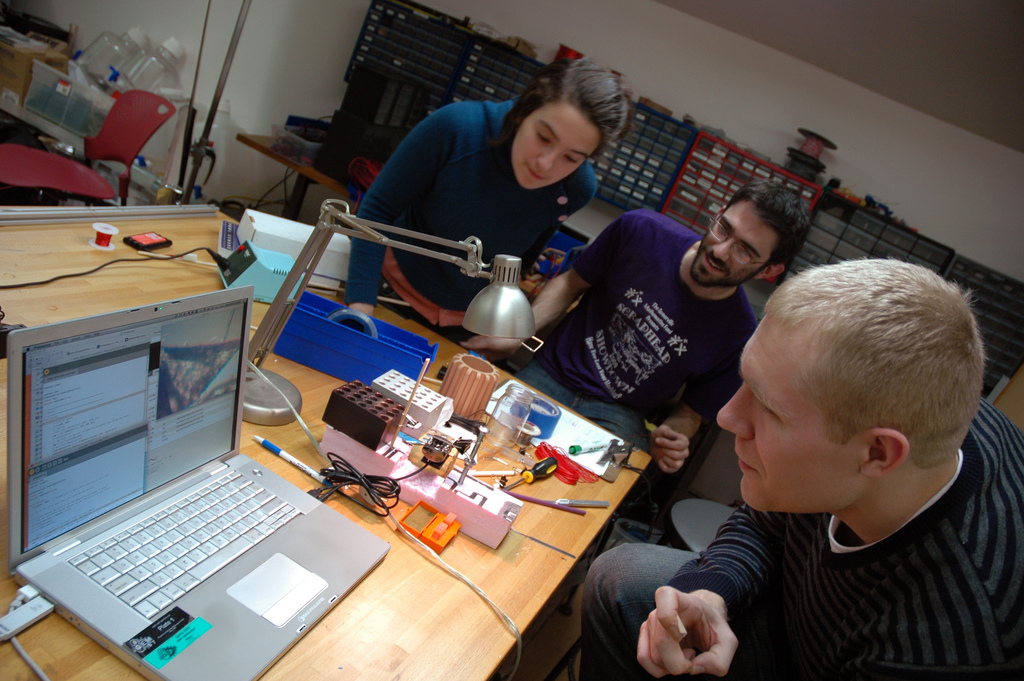
Shaunalynn Duffy, Alec Resnick, and David Thompson lean closer as the ucam's image comes into focus. The camera cost $10 and took 5 minutes to hack.
We hacked $10 webcams into microscopes, a la Hackteria.org at the bosslab + sprout. Yashas Shetty, Jason Bobe, Rich Pell, Myself, and others are planning a worldwide webcam hacking day on January 30th, in conjunction with the UCLA “Outlaw Bio” symposium.
@molecularist (Charlie Schick) posted a great writeup with some photos on his blog.
hello world, ucam style
@jasonbobe was the first to have a cam connected to his laptop and the lens unscrewed and inverted.

Jason testing the ucam: lens unscrewed and inverted, clipped to laptop screen, with an alligator clamp holding a microscope slide above the camera (consider vibration and focal point).
A droplet of saliva dripped onto a microscope slide held above the webcam/microscope (microcam? u-cam? ucam?) showed up as amorphous blobs: Hello World! The inverted lens resting on top of the camera chasis seemed to have a focal plane somewhere inside the lens body. This is when we realized we should screw the lens into the chasis in reverse.

detail of Jason Bobe's laptop w/ skype; soon this ucam will be broadcasting microscopic images all across the world...
@jayunit & David Thompson built an ad-hoc microscope slide holder out of a block of insulator foam, a pencil, two black binder clips, a bolt, a nut, and a washer. By rotating the nut (or holding the nut and rotating the bolt), we could raise and lower the height of the microscope slide.

the nut on the bolt controls the height of the slide above the camera. Unscrew the lens from this particular $10 usb webcam, open the camera body, reverse the lens and screw it back through the camera body inside out, and voila, instant microscope.
I hacked together some rudimentary processing code to access the usb microscope. It seemed to be more reliable than quicktime (or skype) and I was excited about using my favorite blob-detection library on the microscope feed.
You can grab the source here: ucam.
To get the focal plane outside of the lens assembly, we unscrewed the 2 small machine screws holding the camera body together to open the camera then and screwed the camera lens back into the housing from the inside-out such that the the lens was reversed. The part of the lens that had originally been closest to the CCD was now outside the camera body. Then screwed the housing back together.
By rotating the lens and and the nut on the slide holder, we were able to intersect the focal plane of the ucam with the microscope slide. it works!
ucam hello world: looking at streetwater and blood from mac cowell on Vimeo.
12 Dec 2009 – wiki notes.
U.S. Office of Science and Technology Policy soliciting YOUR feedback on "Improving Public Access to Results of Federally Funded Research" until Dec 20, 2009
December 12, 2009
Jonathan Cline
The U.S. Office of Science and Technology Policy, under directives from the President Obama administration, is soliciting public feedback. Note the deadline! (Dec. 10th-20th for this phase)
Policy Forum on Public Access to Federally Funded Research: Implementation
Thursday, December 10th, 2009 at 7:25 pm by Public Interest Declassification Forum
By Diane DiEuliis and Robynn Sturm
Yesterday we announced the launch of the Public Access Forum, sponsored by the White House Office of Science and Technology Policy. Beginning with today’s post, we look forward to a productive online discussion.
One of our nation’s most important assets is the trove of data produced by federally funded scientists and published in scholarly journals. The question that this Forum will address is: To what extent and under what circumstances should such research articles—funded by taxpayers but with value added by scholarly publishers—be made freely available on the Internet?
The Forum is set to run through Jan. 7, 2010, during which time we will focus sequentially on three broad themes (you can access the full schedule here). In the first phase of this forum (Dec. 10th-20th) we want to focus on the topic of Implementation. Among the questions we’d like to have you, the public and various stakeholders, consider are:
- Who should enact public access policies? Many agencies fund research the results of which ultimately appear in scholarly journals. The National Institutes of Health requires that research funded by its grants be made available to the public online at no charge within 12 months after publication. Which other Federal agencies may be good candidates to adopt public access policies? Are there objective reasons why some should promulgate public access policies and others not? What criteria are appropriate to consider when an agency weighs the potential costs (including administrative and management burdens) and benefits of increased public access?
- How should a public access policy be designed?
- Timing. At what point in time should peer-reviewed papers be made public via a public access policy relative to the date a publisher releases the final version? Are there empirical data to support an optimal length of time? Different fields of science advance at different rates—a factor that can influence the short- and long-term value of new findings to scientists, publishers and others. Should the delay period be the same or vary across disciplines? If it should vary, what should be the minimum or maximum length of time between publication and public release for various disciplines? Should the delay period be the same or vary for levels of access (e.g. final peer reviewed manuscript or final published article, access under fair use versus alternative license)?
- Version. What version of the paper should be made public under a public access policy (e.g., the author’s peer-reviewed manuscript or the final published version)? What are the relative advantages and disadvantages of different versions of a scientific paper?
- Mandatory v. Voluntary. The NIH mandatory policy was enacted after a voluntary policy at the agency failed to generate high levels of participation. Are there other approaches to increasing participation that would have advantages over mandatory participation?
- Other. What other structural characteristics of a public access policy ought to be taken into account to best accommodate the needs and interests of authors, primary and secondary publishers, libraries, universities, the federal government, users of scientific literature and the public?
We invite your comments […]
Give government your feedback on how to release data and publications from publicly funded research.
- Register for an account on the U.S. Office of Science and Technology Policy site here: http://blog.ostp.gov/wp-login.php?action=register
- Leave your policy comments on their WordPress blog!
More information is in the U.S. Office of Science and Technology Policy video:


 DIYbio