
Cathal has designed a simple centrifuge using open source hardware technology, and you can order one yourself! (For use as entertainment purposes only, of course; wouldn’t want anyone to save nearly a thousand dollars by not buying real centrifuge now would we?)
Dremelfuge is a rotor designed to fit standard lab microcentrifuge tubes and miniprep/purification columns, to be spun by either a powerdrill or other
chuck-loading machine or by a popular rotary tool.
Dremelfuge features an easy click-in loading system which holds tubes
parallel to the plane of rotation for optimum pelleting and delivery of
force.

Do-it-yourself biology on the rise - 20 Dec 2009 - SF Chronicle (pdf)
SF Chronicle reporter Juliane Guthrie interviews Tito Jankowski, Phil Ross, Jason Bobe, and Raymond McCauley about the DIYbio projects they are working on. They also interviewed Drew Endy about safety and regulatory concerns. The article is online at SFgate.com.
One of the article’s main thrusts is concerned with safety and regulation, or the lack thereof. I know diybio-nyc has been thinking about it and is organizing a round-table in a month or so, and I’ve been throwing a couple of ideas around with people here in boston. Maybe it’s time to set up a safety working group to synthesize the community’s thoughts on the issue with pointers to relevant resources. Is anyone doing this already (there’s some info in the faq).
Happy holidays,
Mac
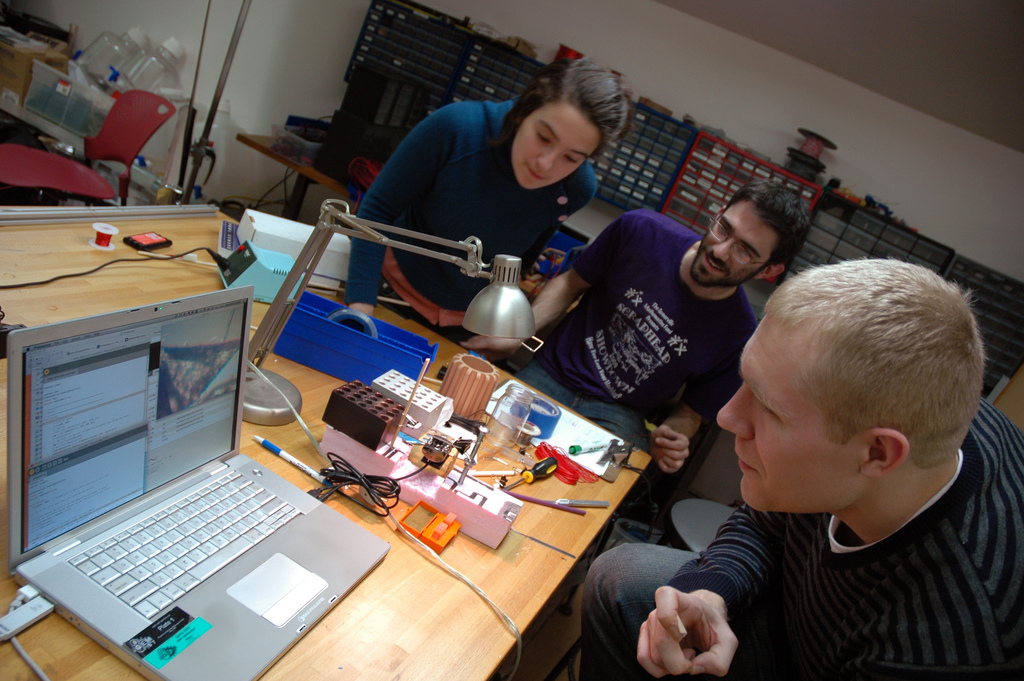
Shaunalynn Duffy, Alec Resnick, and David Thompson lean closer as the ucam's image comes into focus. The camera cost $10 and took 5 minutes to hack.
We hacked $10 webcams into microscopes, a la Hackteria.org at the bosslab + sprout. Yashas Shetty, Jason Bobe, Rich Pell, Myself, and others are planning a worldwide webcam hacking day on January 30th, in conjunction with the UCLA “Outlaw Bio” symposium.
@molecularist (Charlie Schick) posted a great writeup with some photos on his blog.
hello world, ucam style
@jasonbobe was the first to have a cam connected to his laptop and the lens unscrewed and inverted.

Jason testing the ucam: lens unscrewed and inverted, clipped to laptop screen, with an alligator clamp holding a microscope slide above the camera (consider vibration and focal point).
A droplet of saliva dripped onto a microscope slide held above the webcam/microscope (microcam? u-cam? ucam?) showed up as amorphous blobs: Hello World! The inverted lens resting on top of the camera chasis seemed to have a focal plane somewhere inside the lens body. This is when we realized we should screw the lens into the chasis in reverse.

detail of Jason Bobe's laptop w/ skype; soon this ucam will be broadcasting microscopic images all across the world...
@jayunit & David Thompson built an ad-hoc microscope slide holder out of a block of insulator foam, a pencil, two black binder clips, a bolt, a nut, and a washer. By rotating the nut (or holding the nut and rotating the bolt), we could raise and lower the height of the microscope slide.

the nut on the bolt controls the height of the slide above the camera. Unscrew the lens from this particular $10 usb webcam, open the camera body, reverse the lens and screw it back through the camera body inside out, and voila, instant microscope.
I hacked together some rudimentary processing code to access the usb microscope. It seemed to be more reliable than quicktime (or skype) and I was excited about using my favorite blob-detection library on the microscope feed.
You can grab the source here: ucam.
To get the focal plane outside of the lens assembly, we unscrewed the 2 small machine screws holding the camera body together to open the camera then and screwed the camera lens back into the housing from the inside-out such that the the lens was reversed. The part of the lens that had originally been closest to the CCD was now outside the camera body. Then screwed the housing back together.
By rotating the lens and and the nut on the slide holder, we were able to intersect the focal plane of the ucam with the microscope slide. it works!
ucam hello world: looking at streetwater and blood from mac cowell on Vimeo.
12 Dec 2009 – wiki notes.


 DIYbio