
U.S. Office of Science and Technology Policy soliciting YOUR feedback on "Improving Public Access to Results of Federally Funded Research" until Dec 20, 2009
December 12, 2009
Jonathan Cline
The U.S. Office of Science and Technology Policy, under directives from the President Obama administration, is soliciting public feedback. Note the deadline! (Dec. 10th-20th for this phase)
Policy Forum on Public Access to Federally Funded Research: Implementation
Thursday, December 10th, 2009 at 7:25 pm by Public Interest Declassification Forum
By Diane DiEuliis and Robynn Sturm
Yesterday we announced the launch of the Public Access Forum, sponsored by the White House Office of Science and Technology Policy. Beginning with today’s post, we look forward to a productive online discussion.
One of our nation’s most important assets is the trove of data produced by federally funded scientists and published in scholarly journals. The question that this Forum will address is: To what extent and under what circumstances should such research articles—funded by taxpayers but with value added by scholarly publishers—be made freely available on the Internet?
The Forum is set to run through Jan. 7, 2010, during which time we will focus sequentially on three broad themes (you can access the full schedule here). In the first phase of this forum (Dec. 10th-20th) we want to focus on the topic of Implementation. Among the questions we’d like to have you, the public and various stakeholders, consider are:
- Who should enact public access policies? Many agencies fund research the results of which ultimately appear in scholarly journals. The National Institutes of Health requires that research funded by its grants be made available to the public online at no charge within 12 months after publication. Which other Federal agencies may be good candidates to adopt public access policies? Are there objective reasons why some should promulgate public access policies and others not? What criteria are appropriate to consider when an agency weighs the potential costs (including administrative and management burdens) and benefits of increased public access?
- How should a public access policy be designed?
- Timing. At what point in time should peer-reviewed papers be made public via a public access policy relative to the date a publisher releases the final version? Are there empirical data to support an optimal length of time? Different fields of science advance at different rates—a factor that can influence the short- and long-term value of new findings to scientists, publishers and others. Should the delay period be the same or vary across disciplines? If it should vary, what should be the minimum or maximum length of time between publication and public release for various disciplines? Should the delay period be the same or vary for levels of access (e.g. final peer reviewed manuscript or final published article, access under fair use versus alternative license)?
- Version. What version of the paper should be made public under a public access policy (e.g., the author’s peer-reviewed manuscript or the final published version)? What are the relative advantages and disadvantages of different versions of a scientific paper?
- Mandatory v. Voluntary. The NIH mandatory policy was enacted after a voluntary policy at the agency failed to generate high levels of participation. Are there other approaches to increasing participation that would have advantages over mandatory participation?
- Other. What other structural characteristics of a public access policy ought to be taken into account to best accommodate the needs and interests of authors, primary and secondary publishers, libraries, universities, the federal government, users of scientific literature and the public?
We invite your comments […]
Give government your feedback on how to release data and publications from publicly funded research.
- Register for an account on the U.S. Office of Science and Technology Policy site here: http://blog.ostp.gov/wp-login.php?action=register
- Leave your policy comments on their WordPress blog!
More information is in the U.S. Office of Science and Technology Policy video:
Last week I hired Micah & Caroline from WeAreaGoodCompany.com to design an extensible diybio logo and related illustrations. I gave them a quick intro to diybio and synthetic biology (see a lot of design notes here) and asked them to create artwork that could be used by diybio.org and built apon by regional groups + related organizations (diybio-nyc, bosslab, etc.). I stressed extensibility – the final design should support remixing by all interested parties.
Micah & Caroline are about halfway done and I want to show you their work so far and solicit comments and suggestions. Above all the graphics are intended to be a community resource, so they need to be built with community feedback.
They have worked on two things: an extensible diybio logo and diybio themed icons.
logo
Micah & Caroline modified a typeface called “the mix” for the diybio logo to make it look hand-cut. When they are done they will provide the typeface for the community so that any group name can be written with it. As you can see, their current idea has been to cut out illustrations from the “golden days” of amateur science in the pattern of the typeface.

black-filled diybio text & icons
They have garnished this design with a rich wood background which I think goes far in dispelling the typical clinical, clean ethos of science imagery. But it’s also pretty “loud.”
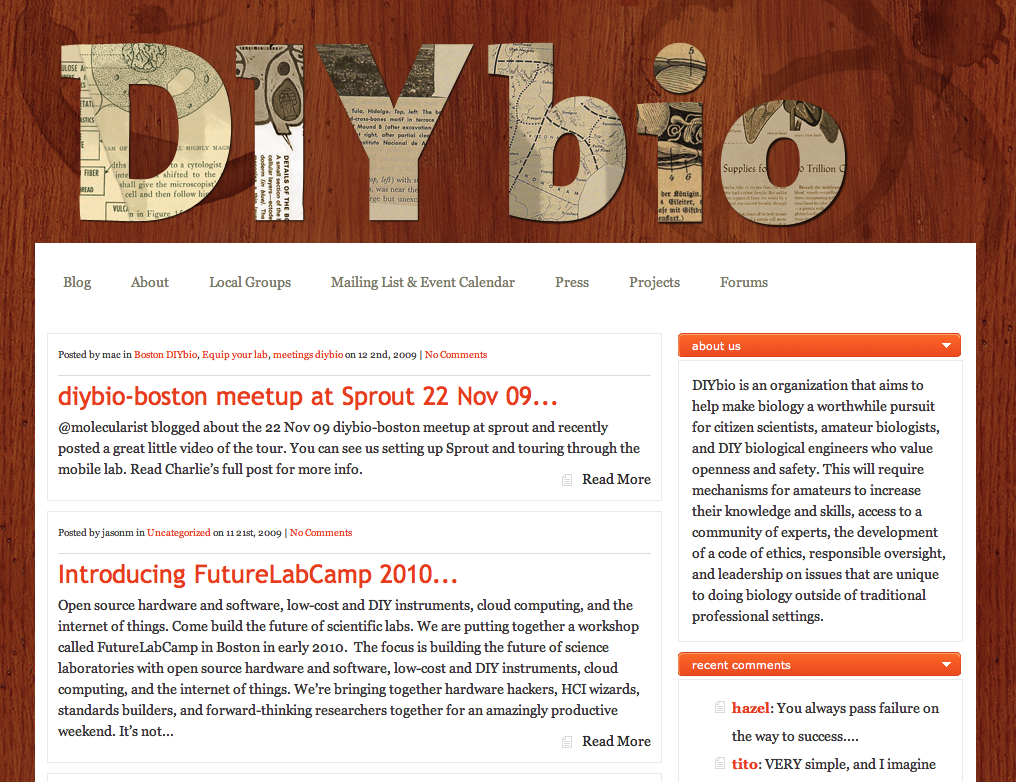
diybio logo cut out of old science diagrams & engravings
icons
I also asked the team to design a set of reusable icons and illustrations that represent things common to diybio activities. I wasn’t very specific.
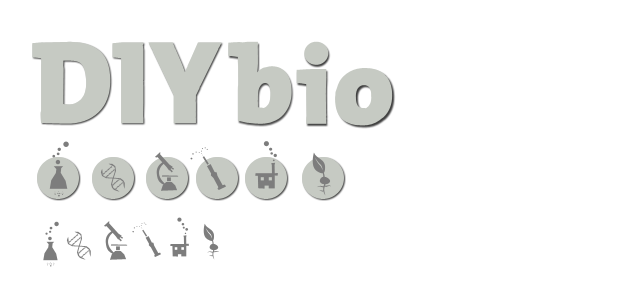
diybio logo and icons grayscale
What 10 icons should I ask them to design? This is really where feedback would be helpful. For instance, we could ask them to design:
A pipet; dsDNA; a microscope; a waste container; a falcon tube; e. coli; yeast; a petri dish; a generic chemical bottle; DNA sequence.
In this version they incorporated the icons into little bottle-cap pins to emphasize DIY approaches. (note: when they are finished they will provide the source illustrator files to maximize these kinds of reuse.)
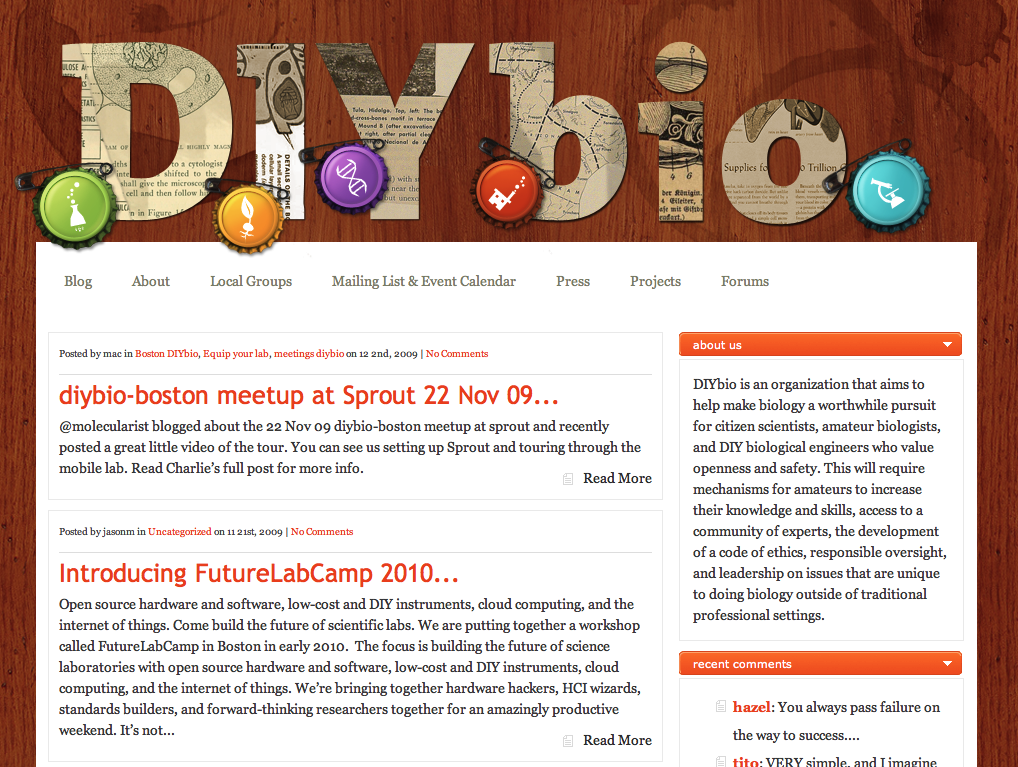
diybio logo cutout of science diagrams with bottlecap logos
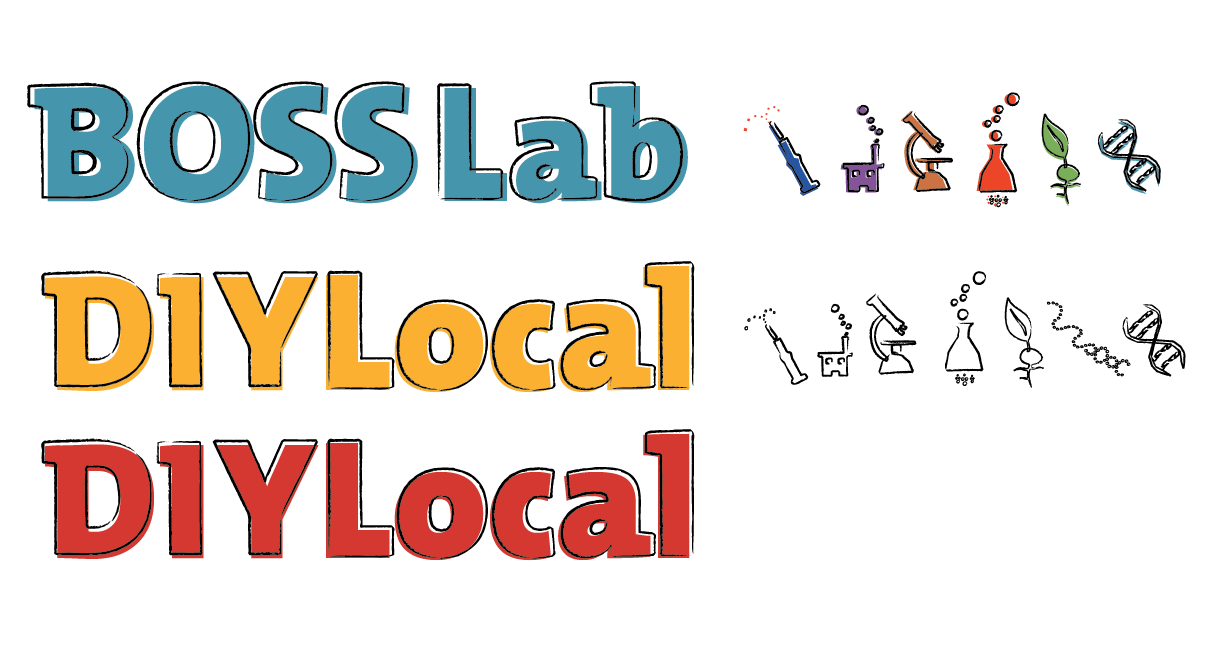
diybio logo variations
feedback
Please please please mail your feedback to this thread on the diybio google group or in the comments below. In particular, consider these two questions:
- what 10 icons should be designed?
- what graphical concepts should comprise the diybio logo?
Go check out my notes for my thoughts. I hope the artwork will be a graphical synthesis of (playfulness + art + DIY) + (science + engineering + biotechnology).
(I’m still thinking about a retro-arcade-game theme…)
Also see these other handy links:
- OpenWetWare went through an involved feedback process when they created their logo. They paid a lot of attention to technical details, like the handedness of DNA.
- Science Creative Quarterly’s merit badges – they designed a TON.
I’ll include my feedback in the comments with everyone else.
All this stuff is licensed CC-BY.
Here I go. Start off with something like “Bryan got to speak at H+ Summit 2009 and spotted some neat numbers.” Maybe this will end up in GBM or H+ magazine as a small blurb?
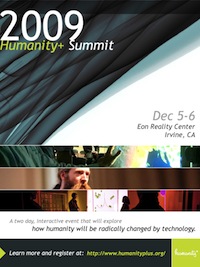 Bryan Bishop presented at the 2009 H+ Summit onopen source hardware and took copious notes. Here he presents some of his favorites:
Patri Friedman. Meeting him in person is like meeting with a living legend. Hell, he wrote the book on seasteading. His talk was short and to the point: let’s make startups for governments and ways of organizing people. You know how everyone says let a thousand flowers bloom? Same thing going on here, except he’s serious about it. The Seasteading Institute is a 501c3 non-profit organization dedicated to living on the high seas and promoting a diversity of ways of living and organizing groups of people. At the end of the talk he gave a shout-out to the DIY scene: 12 miles off the coast, there is no FDA. The talk was recorded and is somewhere here, and here’s the transcript. I didn’t catch the Q&A because I was up next! What a talk to follow.
Todd Huffman also talked (transcript). Todd organized BIL, the simple and free alternative to TEDtalks. Todd spoke about whole brain emulation and his startup, 3Scan. He showed some really amazing videos collected from his team back at TAMU running off of a knife-edge microscope. His plan is to slice and dice brain tissue so as to scan in details all the way down to mitochondrial positions in order to parameterize and seed emulations and simulations of brains.
Gregory Benford (transcript) also showed up and talked about personal genomics, or what he calls “nutrigenomics”. It turns out that he bought the original Methuselah flies. The Methuselah flies were super-longevity flies living well beyond average lifespans. With these flies he sequenced their genome and found particular up-promoted and down-regulated genes that might be causing the flies to live longer. The idea is to then synthesize custom pharmaceuticals that enable and disable gene regulation for different (but targeted) genes in the human body. Greg is really amazing in person, although maybe that’s just me being a fanboy for his scifi after all these years? At some point you go “wtf, I’m having a one-on-one with Gregory Benford!” (He was also at the Singularity Summit earlier this year.)
You should also check out Anselm Levskaya‘s talk on brain input/output projects, Dylan Morris, and Christine Peterson had some good suggestions for not dying.
And one final plug- there’s no transcript for me because I was presenting (!) on open source hardware (1, 2, 3).


 DIYbio