
The Boston Open Source Science Lab (BOSSlab.org)
Hey DIYbio-Boston peeps,
It’s been a while!
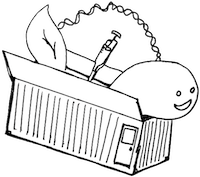
I’ve been making progress on getting us a lab space here in the Boston area. I’ve acquired a shipping container that has a molecular biology lab built inside of it and am spinning up an organization to take care of it. It’s called the Boston Open Source Science Lab, or the BOSSlab (cred for the awesome name goes to a brilliant volunteer at the recent iGEM Jamboree). Some basic info about it online athttp://bosslab.org.
My vision for the space is to develop it into a volunteer research center where PhDs and amateurs can work together to develop and document low-cost, low-waste “open source” tools and techniques for biotechnology and synthetic biology. 12-month goal: build and distribute one unencumbered (IP-free or freely-licensed) BioBrick under the new BioBrick Public License to the DIYbio community, preferably a device with an obvious and fun phenotype. In the process develop comprehensive and practical resources and protocols for DIY biobrick creation and use that bridge the gap between high-school and PhD-level lab instructional material. Along the way, we’ll figure out how to make it all financially sustainable with a combination of workshop tuition, membership fees, donations, and grants. We might even be able to put together some DIY kits.
For now, the BOSSlab is chilling out on a low-cost industrial lot near Fresh Pond (NorthWest Cambridge) until we can find a space for it closer to public transportation, universities, utility hookups, etc.
The fine folks at Sprout (http://sproutward.org) are coincidentally in the process of setting up a community wetlab space as well and are excited to host us until the BOSSlab is ready to open its doors.
I propose we meet up at Sprout this coming Sunday at Noon to:
- set up Sprout’s wetlab space
- review the great projects that were brought up during the iGEM Jamboree DIYbio meetup
- and finish with a tour of the BOSSLab, which is about 15 minutes away
You can get directions to Sprout here: http://thesprouts.org/contact
Check out the diybio-boston mailing list for updates and watch @bosslab on twitter.
Cheers!
Mac
A bunch of interesting projects ideas were discussed at the DIYbio meetup during the iGEM Jamboree 2 weeks ago – here are my notes:
- Yashas Shetty wants to organize an international DIY microscope building session and subsequent videoconference for early December based on his DIY Microscope guide. See http://hackteria.org/wiki/index.php/DIY_microscopy for instructions
- Alex Hornstein told us he had just been diagnosed with Type 1 diabetes and wanted to synthesize his own insulin, DIY-style. Would we help? Hell yes! A grad student from Harvard who had dropped in pointed out that the Registry of Standard Biological Parts already has an insulin-generating biobrick. Alex and the grad student went off to talk.This is radical self-actualized DIY theraputics. Extremely controversial.
- A variety of brave souls volunteered to start writing for the (so far, low-volume) blog at diybio.org in an attempt to amplify the signal that inevitably gets lost in the noise on the diybio mailing list and in the DIYbio ecosystem of blogs. Want to help? Email contact@diybio.org for an account.
- volunteers from each DIYbio region present (Ellen from NYC, Tito from SF, Paul from MIT & myself from Boston) thought it would be useful to describe the organizational blueprint for the local group in a central place, perhaps on the new forums, for comparisons sake and to help new groups bootstrap more intelligently and more quickly.
- Alec Nielsen, myself, Jason Bobe, David Thompson, and iGEM volunteer from MSU, and the DIYbio-NYC folks all were excited about developing a standard DIY-friendly DNA barcoding protocol. 16s rDNA sequencing of soil microbes was the initial suggestion, followed by interest in plant barcoding, in which sample collection and genome isolation may potentially be easier (using the COI gene).
- I announced the Boston Open Source Science Lab, a volunteer research center where PhDs and amateurs can work together to develop and document low-cost, low-waste “open source” tools and techniques for biotechnology and synthetic biology. 12-month goal: build and distribute one unencumbered (IP-free or freely-licensed) BioBrick under the new BioBrick Public Agreement to the DIYbio community, preferably a device with an obvious and fun phenotype. In the process develop comprehensive and practical resources and protocols for DIY biobrick creation and use that bridge the gap between high-school and PhD-level lab instructional material. Along the way, we’ll figure out how to make it all financially sustainable with a combination of workshop tuition, membership fees, donations, and grants. We might even be able to put together some DIY kits.

Scientific American Oct 1953 - Evolution in Bacteria
DIYbio aims to be “the institution for the amateur,” developing and providing access to all of the resources a professional might have and an amateur might want, such as equipment, protocols, access to literature, etc. And we are collectively doing so in a distributed fashion right now.
But we are also doing something more, something that will occur slowly, over long time-scales. We are helping lay the foundations for cultural shift. We are laying the foundations for broad, deep, domestic understanding of science and technology.
We are proving that the cultural barriers to practice science in general, and biotechnology in particular, are imaginary. We are proving this by doing it ourselves. We are building a familiarity with the practice and product of science and slowly demonstrating that it can be a cultural activity like musicianship or cooking or solving sudoku puzzles. We are domesticating biotechnology.
As Sophia Roosth recently pointed out, we are proving that “the biological is not something cordoned-off in labs, but something quotidian, personal, and apprehensible,” that we are “intentionally destabilizing what it means to ‘do science’.”
Why is the domestication of biotechnology important? Listen to how W. Brian Arthur begins his recent book, The Nature of Technology:
We are attuned in the deepest parts of our being to nature, to our original surroundings and our original condition as humankind. We have a familiarity with nature, a reliance on it that comes from three million years of at-homeness with it. We trust nature.
When we happen upon a technology such as stemcell regenerative therapy, we experience hope. But we also immediately ask how natural this technology is. And so we are caught between two huge and unconscious forces: Our deepest hope as humans lies in technology; but our deepest trust lies in nature. These forces are like tectonic plates grinding inexorably into each other in one long, slow collision.
The collision is not new, but more than anything else it is defining our era. Technology is steadily creating the dominant issues and upheavals of our time. We are moving from an era where machines enhanced the natural—speeded our movements, saved our sweat, stitched our clothing—to one that brings in technologies that resemble or replace the natural—genetic engineering, artificial intelligence, medical devices implanted in our bodies. As we learn to use these technologies, we are moving from using nature to intervening directly within nature. And so the story of this century will be about the clash between what technology offers and what we feel comfortable with.
By domesticating biotechnology, we are helping society temper its natural mistrust of technology.
DIYbio is just one stone in this cultural foundation, set next to other DIY communities and Citizen Science projects and part of the broader resurgence of DIY culture championed by publications such as MAKE, President Obama, and perhaps the forebears of the internet itself.


 DIYbio