

diybio faq at openwetware.org
Bryan Bishop has herioically created a DIYbio FAQ (three cheers!). In the interest of neutrality, I copied his latest version to OpenWetWare/wiki/DIYbio/FAQ today and I encourage everyone to edit that version mercilessly. Otherwise Bryan will become the official keeper of the holy DIYbio FAQ flame and the canonical version will reside at heybryan.org – this may be a fine solution for now.
The FAQ contains information on Getting Started with DIYbio, local DIYbio groups, Synthetic Biology, iGEM, videos, Keiki gels, and MiniFAQs on DNA synthesis and microfluidics. Obvious content to expand are the sections on social and legal issues, basic wetlab equipment, lab services available to amateur biologists, and current projects in the community.
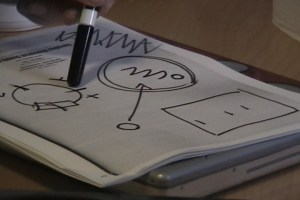
Step 1. Planning our experiment
The pressure cooker shot out steam, like an enormous teapot. At over 200˚F, steam had just sterilized our liquid agar, the favorite food of growing cells.
We’re on our way to make glowing cells with the Carolina Sciences “Green Gene Colony Transformation Kit” (aka E. Coli K-12 + a GFP plasmid). This first step for DIYbio SF was a long time in the making!
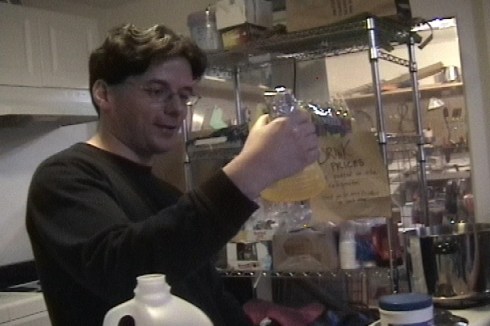
Step 2: Josh measures and mixes LB agar
At the beginning of March, Praveen and Marnia began working with Noisebridge, a local hackerspace, to put together a Lab Safety and Ethics page. Tim ordered the Carolina kit and stored it at his apartment. Micah offered to donate a fridge, Meredith volunteered her pressure cooker , and Marnia brought a digital scale.
This past weekend, 5 DIYbiologists met at Noisebridge in the Mission district: Marnia, Josh, Tim, Micah, and myself, Tito.
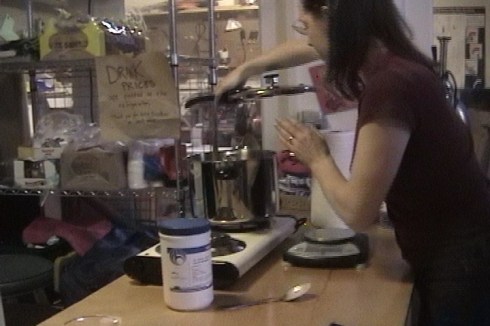
Step 3: Marnia turns on the pressure cooker
We started the session by cleaning out a fridge donated by Micah and talking through the safety aspects of our tools and materials. We agreed that any broken glassware would need to be cleaned up immediately and Marnia showed us how the pressure cooker worked.
To the right, you can see the 4 steps that we took in order to make our plates. Marnia will be seeding the E. Coli K-12 on these plates and we will be adding our GFP DNA plasmid to these cells during our next session.
We will be completing this kit over 3 “Glow in the Dark” sessions:
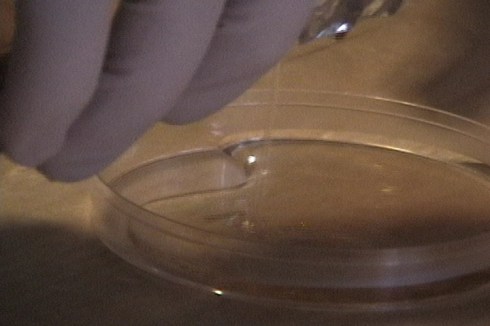
Step 4: Pour and refrigerate agar plates
1. Making Agar Plates
2. Growing glowing GFP cells
3. Visualizing DNA with Electrophoresis
Kit: Carolina Green Gene Colony Transformation ($49)
Materials used:
Petri dishes
LB Agar
Equipment used:
Gloves
Scale
Pressure Cooker
Flask
DIYbio is a new and exciting topic — as a community we focus on making science safe and approachable by understanding our materials, following safe practices, and tackling tough issues like public perception. As well, remember these important areas outside of the science itself, especially when working in someone else’s space: schedule space with the owner, get everything approved, and say many “thanks” afterwards!
Thank you to Noisebridge for hosting us as we boot-up DIYbio SF!
Our project was accepted for the MAKE Magazine “Maker Faire“ — we’ll be showing off our cells from May 29-May 31st in San Jose, California!
Microfluidics, a competition for free sequencing, an abundance of ideas for cheap lab equipment both second-hand and DIY, and thoughtful discussions on the current state of public perception and the future of regulation have made for quite an interesting week in DIYbio.
Projects
Bryan Bishop and others experiment with Sharpies and glass slides for making DIY microfluidics.
Why not sequence a genome? Sandra Porter suggests the idea and and Jason Bobe shares a writeup on a likely partner for this, Cofactor Genomics. No sooner does Jason suggest raising funds, and pledges $100 to kick-start the idea, than Tito Jankowski mentions the fact that Cofactor is running a contest for a free ~700Mb sequencing project for education. Follow along on the “Why not sequence a genome?” thread.
Equipment
Lots of people ask about the best way to get started with a DIY lab setup for doing amateur biology. It turns out that now is a great time to shop for your lab on eBay! Aaron Hicks shares his experience on in the “DIY Lab Setup” discussion thread.
Dan Heidel posts a review of a nice (and affordable) $100 pipetter set.
Cheap CCDs might enable building spectrophotometers and using dynamic light-scattering to probe the sizes of molecules in a solution in the “DIY biophysical setups?” thread.
Regulation and perception
An article from GenomeWeb gets us thinking about the perception by the public and the larger scientific establishment. A prolific discussion ensues.
Bryan Bishop brings up a new report out of U. Virginia “New Life, Old Bottles: Regulating First Generation Products of Synthetic Biology“, with video.


 DIYbio