
As molecular tools get cheaper, and the know-how for using them more widely distributed, I think we’re going to see a renaissance in science. The peculiar feature of this renaissance is that its going to take place outside of “science proper”, away from the universities which dominate now, and funded out-of-pocket by enthusiasts without PhDs.
The democratization of technologies will enable more people to do their own science: make hypotheses, design experiments, collect large data sets, and apply a mixture of reasoning and cloud computing to make discoveries. Perhaps we’ll see a multi-author journal article published written entirely by people without PhDs and no institutional affiliations. Although it sounds crazy, I’m not sure it is.
Today GTO pointed to a New York Times article about a few a high school students that were curious to know whether patrons of NYC restaurants and grocers were getting the seafood they ordered, or if instead, some foods were often substituted by others. So, they collected seafood specimens and sent them for genotyping. One quarter of the fish they collected were mislabeled. What these high school students were able to do is remarkable, and more projects like it will soon follow:
“What may be most impressive about the experiment is the ease with which the students accomplished it. Although the [genetic] testing technique is at the forefront of research, the fact that anyone can take advantage of it by sending samples off to a laboratory meant the kind of investigative tools once restricted to Ph.D.’s and crime labs can move into the hands of curious diners and amateur scientists everywhere.”
How far might the paradigm of DIYscience be extended? Could amateur biologists around the world organize around a grass-roots experiment, collect specimens, generate and share data, and make discoveries? What might that experiment look like?
-Jason Bobe
Some scientists are really making an effort to make their own labs environmentally benign. I discovered the term in reference to Angela Belcher’s work using environmentally benign viruses.
One goal for amateur biologists and DIYers is to figure out how to operate in ways that are “environmentally benign”, especially in the following areas:
(1) REAGENTS: Can they be stored safely?
(2) EXPERIMENTAL OUTCOMES: This may be most important for SynBio experiments. Anything that cannot live in the backyard, or safely go down the sink, might be a problem for researchers at home (and their neighbors).
(3) WASTE: Unlike institutional scientists, amateur biologist working at home may not have access to appropriate waste disposal, other than say, a workroom sink and a trash can.
For DIYbio to be accepted as a hobby that is permissible for members of any local community to engage-in, concerns about environmental impact and safety will need to be addressed. The development of a framework which identifies practices as “environmentally benign” or not, might be a good place to start.
-Jason Bobe
Thanks to everyone for a great meeting: Michael, Jason, Sophia, Benny, Topher, Ricardo, Alex, Alec, nublabs, and everyone else.
Overview:
DIYbio 2 & 3 were focused on gel electrophoresis – we started by researching all the amateur gel protocols we could find online (notably the MacGuyver Project and the MAKE protocol, the latter of which we decided to focus on) and making a shopping list of materials we would need to build the complete gel apparatus, make a gel, and stain DNA. We got Agar agar powder from a health food store on ebay and Potato Dextrose Agar and sybr green from a lab equipment reseller on ebay.
Basically we over-stained the gels with methylene blue and couldn’t visualize anything because the entire gel was a solid blue.
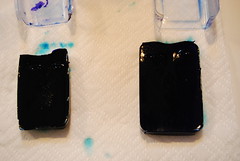
Also, we used metals that were way too reactive as electrodes in the gel box and the redox reaction that they enjoyed probably ruined the voltage field across the gel.

That said, I think we accomplished a lot, learned a lot, and somehow managed to do everything the protocol required in a spontaneous, parallel way – to me, that was the best part about the event. I remember stepping back at one point and being amazed at how well everyone was working together without any central plan: Topher and Jason were improvising with the stovetop and microwave to boil the agar, Sophia and Mike were cutting up charlie cards to make gel combs, and Benny, Ricardo, and the nublabs crew were constructing and taping gel trays and boxes. It was awesome.
What I learned:
1. We were not as rigorous with the materials as we needed to be. One of our main problems was getting the concentration of the gel just right, which was difficult because the packages for our agar didn’t list the original concentrations. In general, we followed the MAKE protocol too specifically while using supplies that came with ambiguous descriptions at best. DIYbio protocols we develop should be designed to help the user understand the basic principles of the operation in a way that enables them to improvise successfully with non-standard materials.
2. We should have had a solid understanding of how to dispose of all the materials involved before beginning as well as exactly what the potential risks involved were (very low – probably the biggest risk was spilling molten agar) and what to do in case something went wrong.
3. It would have been better to have built all the equipment in one meeting and then used it in a second. Trying to do both was a little too long.
Next week we are going on a tour of the Boston FabLab, courtesy of our friends at NubLabs – meet at the FabLab at 7:00pm on Thursday, 17 July 2008.
See you then!
Mac
p.s. go comment on the flickr photos!


 DIYbio