
Charlie Schick is an ex-scientist and determined practical microbiologist. He writes about science, media, and other lofty subjects at http://molecularist.com
Long ago, people discovered that not all food-spoiling processes were harmful. Indeed, people have harnessed fermentation, a spoiling process, to preserve foods – beer, wine, cheese, sauerkraut, cider, kimchee, yoghurt, and, of course, surströmming (you won’t believe what it is).
To me, humans have always been practical microbiologists: we probably settled down to farm barley for beer, one of the oldest pieces of writing is a recipe for beer, and it’s not surprising that early biochemists studied enzymes in the fermentation process.

The ancient (1800 BC) sumerian Hymn to Ninkasi encodes a rudimentary beer recipe
For us DIYbiologists, making foods like beer or yoghurt offers a great way to learn sterile techniques, handling of microorganisms, and many of the principle of microorganism culturing – growth media, inoculation, and strain growth conditions.
I brew beer and make yoghurt. Making yoghurt is stupidly simple. Starters are available from any live-culture yoghurt found in the supermarket. And I use mason jars (usually from spaghetti sauce) for the fermentation.
Brewing beer from malt extract doesn’t require an inordinate amount of time or equipment. Brew shops have various strains of yeast you can use as a starter. And if you’re adventurous, you can capture natural bacteria and yeast to form a starter.
Do you ferment anything? Beer, wine, or cider? Do you use microorganisms for food production?
Silkworms have been engineered to produce a more durable silk by augmenting them with properties from spiders. The applications of the transgenic silk include textiles, sutures and wound healing, and even new bulletproof materials.
(HT Christina)
—
See also a recent paper on the miraculous spidersilk produced by “Darwin’s bark spider”, Agnarsson et al. 2010. Bioprospecting finds the toughest biological material: extraordinary silk from a giant riverine orb spider. PLoS One 5 e11234 doi:10.1371/journal.pone.0011234
Dr. Todd Kuiken is a research associate for the Synthetic Biology Project at the Woodrow Wilson International Center for Scholars. He is collaborating with DIYbio.org on a project to ensure safety within the rapidly expanding community of amateur biologists.
If the “MAN” was just one man, dealing with new and exciting movements such as DIYbio would be rather easy. Unfortunately the “MAN” consists of numerous federal agencies ranging from the FBI to the EPA, all with different jurisdictions and oversight concerns. Add to that state and local agencies, neighborhood associations and your curious neighbor looking over the fence and the complexity of engaging with all of these groups becomes clear. The DIYbio community needs to take these agencies concerns seriously, as I think we are doing, and turn them into excitement over this new field of biology and the larger movement of citizen science as a whole.
As I began talking about DIYbio with various agencies a theme began to emerge amongst those who were tasked with “oversight”, for lack of a better word, of DIYbio. There was a general excitement about the community and the conversation frequently turned to “remember when science was fun”. While these various agencies have legitimate concerns surrounding the DIYbio movement, the conversations thus far have been positive and seem to be more about helping the movement move forward safely while encouraging more people to get “excited” about science again. By no means do I think this will be an easy task, but an exciting one as we begin to engage the larger public and move deeper into the caverns of regulations, local ordinances and address people’s fears and concerns about moving into the realm of citizen science. I believe strongly that if we follow three simple principles we can calm these fears and produce an environment where the DIYbio community can flourish and the larger citizen science movement can grow.
1. Turn concern into excitement
2. Make science fun again
3. If we engage them they will get it
I recently finished reading “The Radioactive Boy Scout” by Ken Silverstein, which describes the true story of a young man named David who over the course of his childhood became fascinated with DIYchemistry and by the time he graduated high school had designed and built a small nuclear reactor in his backyard (with a little help from a book published in 1960 called “The Golden Book of Chemistry”, long out of print a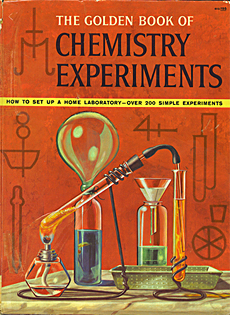 nd probably for good reason, but in short, has some pretty amazing experiments designed for the DIYer, including how to make chloroform!). In the end the EPA arrived, tore down his makeshift lab and turned his family’s suburban Detroit backyard into a Superfund site. This true story is an excellent example of how curiosity and people’s desire to explore science can both lead to pretty amazing accomplishments, from a technical standpoint, but can also carry with it serious safety concerns and potential over reaction by the federal government. I plan on writing future posts describing the significance of this story and how it relates to the DIYbio movement and the lessons we can take from it in order to better engage with the “MAN”.


 DIYbio