
Daniel Grushkin is a science journalist who has written for numerous national publications. He’s a cofounder of GenSpace, New York’s first community lab.
 It’s been 25 years since Steven Levy came out with his seminal book Hackers, and we still can’t agree on a definition for them. Hackers are deft programmers and designers, they’re whiz kids who break into computer systems, they’re guys who wear leather overcoats à la The Matrix.
But let’s face it: in popular culture the term “hacking” is cool because it suggests a reversal of power. People who we thought were powerless turn out to be powerful, and those who we thought all-powerful end up weak (or at least silly). It’s cool when a 7-year-old blind boy figures out how to trick phone systems into giving him unlimited free calls by whistling at the right pitch. It’s cool when misfits take down a shady company by exposing their secrets (see Wikileaks or Lisbeth Salander).
It fulfills a fantasy we all have—that through moxie and smarts the little guy can upend the system. (I suspect that if you don’t consider yourself the little guy, then you don’t find it that cool.) But without the little guy on top, it doesn’t come off. Case in point, when China launches a cyber attack on the Pentagon, or when a government agency hacks into the little guy’s computer, it’s not that cool. Actually it’s scary.
I’m not sure who coined the term biohacker, but it sounds super- f#@ing cool. To others it sounds super-f#@ing scary. Unpack the term, and I’ll show you why.
You and I are the little guys in the biohacker scenario, but who’s the big guy? Where’s the reversal? At first you might think, ‘Oh, it’s the corporations and universities that spend billions to do what we’re doing on the cheap.’ I don’t think so. Though we may one day democratize science, if anything, we operate in parallel to these institutions.
I think the phrase biohacking suggests an even bigger “big guy,” at least it does to the popular press and culture-at-large. Hacking, at least in this context, assumes that the system has a purpose. When a hacker hacks a system he subverts its original purpose for his own. The little boy takes a system designed to trade telecommunication for money and makes it free. The misfit takes a system originally meant to secure information and turns it into a system that reveals information.
Similarly, for many when you use the term biohack, embedded in the notion is that biology has a purpose, that the designer (presumably God) created it to fulfill that purpose, just like the phone company or the security system. To hack it is to somehow subvert the design, and through it, supplant the designer (again, presumably God). Now granted, if you took an insider’s view of the term “hack” this would all seem preposterous. But look at this graphic from The Economist illustrating the creation of the first synthetic bacteria. That’s man playing the role of God in Michelangelo’s Sistine Chapel.
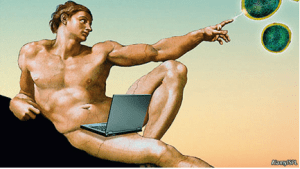
Credit: Economist, May 20th 2010
And you wonder why some of the public sees us as dangerous (parables like the Tower of Babel follow thereafter). At the same time, for others it’s also the reason why “biohacking” seems so cool (in this case, fantasies of creating a more logical world follow thereafter). Because, in a way, it’s the ultimate reversal of power: Hello God, here comes mankind.
Replace the theological with a Darwinian lens and the term again degrades into nonsense. Why? Because “purpose” is a term that doesn’t apply to evolution. A firefly shines bright not because it was designed to, but because it found utility in a string of mutations. Life is a MacGyver, “purpose” only comes after the biological change is made. So if you put the gene to shine bright in another organism (which we do), you are not subverting what some might call “divine will.” You are, however, throwing your own purpose into that life. Whether that organism finds utility in it is up to the organism (and the conditions you set).
Back to the term biohacker: I’m not saying you shouldn’t use it. Go ahead. But when you do, be aware of the associations you’re drumming up. Personally, it’s not worth it because the associations just don’t fit my worldview.
The suits think you can’t do biotech out in the garage. But the suits are wrong.
Meet Eri Gentry, queen of the bio-curious. In 2009, after the recession hit and every biotech company around was going belly up, Gentry went shopping. She picked up over a million dollars worth of lab equipment for $30,000 (around £20,000), installed it in her garage and invited her friends over to play. And her friends invited their friends and pretty soon Gentry was at the front end of the DIY biology movement.
Read the rest of the article at Wired:
http://www.wired.co.uk/news/archive/2010-07/15/eri-gentry-garage-biotech-revolution
More information about BioCurious at: http://www.biocurious.org
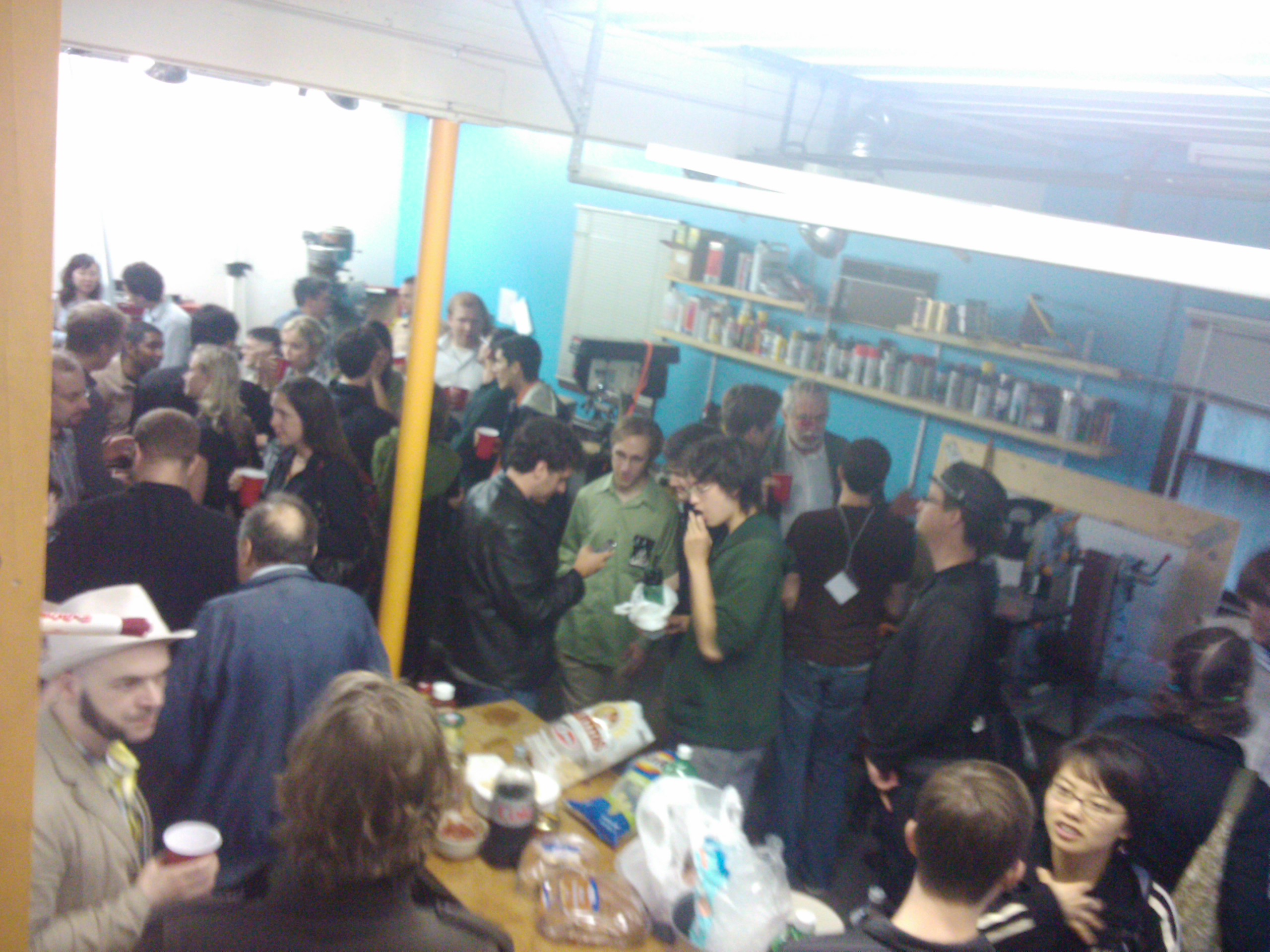
transhumanists sip beer and munch on charred meat at the h+beer meetup post-conference on Saturday night
Saturday, 12 June 2010, 6PM to 8PM+ at Sprout (map).
The H+ Summit is a two day event that explores how humanity will be radically changed by technology in the near future. Visionary speakers will explore the potential of technology to modify your body, mind, life, and world. It’s all happening this weekend at the Harvard Science center.
H+beer is a free public event for h+summit participants and local technologists, hackers, artists, intellectuals, diybiologists, grad students, h-, and other ilk for socializing and discussion in the early evening amongst the charming light manufacturing equipment at Sprout, a local hackerspace*.
Refreshments (free beer) and snacks will be provided. Since we’ll be in a hackerspace, feel free to augment your talking with hacking to illustrate your conversation.
agenda
- h+ participants
- local hackers, artists, intellectuals, and h- folks
- beer
- snacks
- brain uploading machines
h+?
What will it mean to be a human in this next phase of technological development? How can we prepare now for coming changes? We foresee the feasibility of redesigning the human condition and overcoming such constraints as the inevitability of aging, limitations on human and artificial intellects, unchosen psychology, lack of resources, and our confinement to the planet earth. The possibilities are broad and exciting. The H+ Summit will provide a venue to discuss these future scenarios and to hear exciting presentations by the leaders of the ongoing H+ (r)evolution.” hplussummit.com/
Map
Tweets
//
* Sprout actually is not a hackerspace per se, but a small social design firm building resources to enable education through experimentation. A side effect of their current efforts is the public workshop they run. Learn more at http://thesprouts.org.

will post-humans enjoy beer-pouring?


 DIYbio