
Howdy, DIYbio! Here are some great threads that have sprung up in the last two weeks. Do discuss!
SageBase – Sean Zuzu mentioned that Merck just pledged a ton of high-resolution, very expensive data to the public domain, along with some software and other resources to make it work.
Legislation – Daniel Crookston posited that DIYbio is eventually going to face government regulation, and that we should consider the shape of self-regulation. Drew Souza, who “is involved in the federal government’s current efforts to address the risks posed by synthetic biology,” weighs in.
DIY competent cells – Sgt. York proposes DIY protocols for making competent cells, and many folks join in. There’s also a discussion of winning cheap electroporators on eBay.
What are Minipreps, anyway? Cory Tobin and Dan Heidel discourse on a variety of methods for purifying plasmid dna, including “salting out” with ethanol precipitation, chloroform precipitation, and CsCl ultracentrifugation.
DIYbio and Syn Bio software – Jason Morrison asks what kinds of software people would like to see or are currently working on. An open-source alternative to VectorNTI seems to be a popular want. Clotho is a great start, and a project that people should contribute to. Clotho has been described as A Plasmid Editor” for BioBricks.
Lego tube shaker – Douglas Ridgway shares a Lego tube shaker that his son built, and Andrew Hessel and Bryan Bishop chip in with suggestions for furthering the prototype and a DIYbio Kids group and Saturday morning show.
Well, that’s it for DIYbio – if you’re up for cooking up a batch of Ultimate Breakfast Sausage or Chocolate Enchiladas, you should check out this week’s MAKE Blog “Weekend Builder” email in my inbox. But if you’re up for cooking up a batch of RFP or gel boxes, let us DIYbioers know!
This week: Gel electrophoresis in a straw
Hi everyone — Thoughts and discussions took a backseat to projects and results. This week we had everything from starting DIY iGEM Teams to sharing results of straw electrophoresis. Check it out!
Projects:
- iGEM Team – Mac Cowell invited everyone to start a DIY iGEM team in 2009. (thread)
- Gel electrophoresis – Tito Jankowski ran gel electrophoresis in a straw. The instructions are on OpenWetWare. (thread)
- DIY PCR – Bryan Bishop wants a cheap PCR machine. (thread)
- DIY Spectrophotometer – “Let’s not concentrate on making duplicates of old technology; let’s make something better.” – Tom Knight (thread)
- The Toothbrush Genome Project – Andrew Hessel invites us to know more about the bacteria in our mouths (thread)
- DIYbio Educational Outreach – Julie Norville starts the DIYoutreach group (thread)
Links and Discussion:
- Defining and shaping DIYbio culture (Security, Safety, and Responsibility) is discussed by Roger Brent and others (thread)
- Do-it-yourself PCR by Scientific American is brought to attention by Reshma Shetty (thread)
- Can ‘open peer review’ work for biologists? Jason Morrison and others discuss an article from Nature (thread)
- Flu biology: Lora wonders if we can sequence different strains of flu (thread)
UPDATE 10 April 2009: iGEM Closes Doors to Amateurs
The International Genetically Engineered Machine competition (iGEM) is about 5 years old now and bigger than ever.
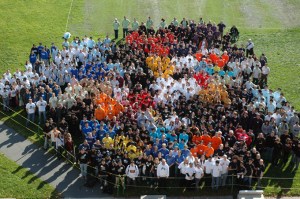
iGEM 2008 at the Jamboree
More than 1000 students are expected to participate in 2009 by applying the principles of synthetic biology and using a kit of standard biological parts to try and design novel biological systems. The Registry of Standard Biological Parts (hosted by MIT) maintains a collection of the components and full systems each team creates for the competition. After the summer, all the teams gather at the iGEM Jamboree to present their work for awards and prizes.
All in all, it’s an amazing competition generating tons of new innovation in synthetic biology. The fixed deadline and possibility of winning prizes motivates fast, concrete results and helps teams get funding (there is a psychological shift: donors are funding a team with the prospect to win instead of basic research).
So, who wants to start an iGEM team? Because iGEM is opening its doors to the wider community of biohackers for the first time this year with a non-institutional teams division. I spoke with Randy Rettberg on Friday about the specifics:
- Team registration will be $500, due March 31.
- There will be an additional per-person Jamboree fee later
- All teams will have access to iGEM Partner deals ($0.20/bp synthesis from GeneArt; MatLab + simbiology toolkit)
- All teams can request parts from the Registry. Requests will have to be approved by a Safety Committee.
- Each team will get to present their work with a 5-minute talk and a poster at the Jamboree
- The Jamboree will be Oct 31 – Nov 2.
For more information about iGEM, visit: http://igem.org
This is the first post in a series about iGEM, the Registry of Standard Biological Parts, and Synthetic Biology.


 DIYbio